Postingan

OPINION: Age of Chimerica?

Gambar
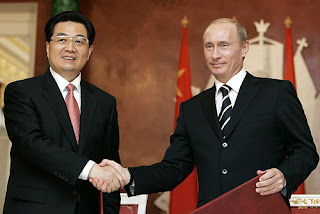
The Jakarta Post, 28 November 2009 Continuity, not change, is what most Chinese elites believe they will see in the relations of two global titans — the US and China — and has been confirmed by both heads of state during recent Barack Obama’s visit to China. It would be a continuity based on common awareness and acknowledgement of the interconnectedness of their fate and the effects of their interactions with the global community. It is also a continuity driven by compromise to prioritize the economic slump, while each strives to be one step ahead in the realignment of global power constellation. Security concerns, such as the denuclearization of the Korean Peninsula and Iran, as well as the US desire for China to play some role in Afghanistan and Pakistan, heighten the need for compromise. Even more pressing is the cooperation in pushing for greater and more comprehensive climate change policies ahead of the Copenhagen climate conference. In his earlier campaign speech, O...

OPINI: C(h)ina

Gambar
Kompas, 28 Oktober 2009. Sebulan ini, Beijing sibuk menyiapkan perayaan 60 tahun Republik Rakyat China. Tak hanya itu. Media penuh program patriotik. Parade disiapkan, memamerkan kekuatan militer dan budaya China. Film epik Berdirinya Sebuah Republik yang melibatkan artis-artis besar seperti Jackie Chan, Jet Li, dan Andy Lau memecahkan rekor penjualan tiket terbesar. Hajatan sepekan itu ditutup pergelaran opera Turandot karya Puccini di megastadium Sarang Burung oleh sutradara Zhang Yimou, sebagai simbol ”China yang baru”, perpaduan budaya tradisional Kerajaan Tengah dan republik yang mendunia. Namun, di sela-sela kemeriahan pesta, keamanan ibu kota dan wilayah rentan, seperti Tibet dan Xinjiang, diperketat. Warga lokal, sejumlah diplomat, dan wartawan asing yang tinggal di sekitar Tiananmen mengeluhkan peringatan untuk tidak membuka jendela saat parade berlangsung. Akses internet kian dibatasi, bahkan Facebook dan Twitter diblok. Apa yang sebenarnya terjadi dalam merefleksikan e...

OPINION: Chinese Indonesians' president?

Gambar
The Jakarta Post, 28 June 2009 In this newspaper's June 24 edition, Mario Rustan wrote a piece on the Chinese Indonesians' dilemma in voting for the president and, while acknowledging the diversity of Chinese Indonesian's political preferences, went further, describing what he called the community's "general attitude and behavior in politics". The general message of Rustan's article is that there has been a heightened sense of political awareness and assertiveness amongst Chinese Indonesians. Rustan's article made a fair assessment of the political preferences of some, but definitely not all, Chinese Indonesians. His arguments regarding the Chinese Indonesian's inclination that Megawati was the "obvious choice" in 2004 need to be further pondered. Furthermore, we need to be extra-critical in pondering the assessment he made on the current elections. It is regrettable that Rustan pointed out that, in the eyes of Chinese Indonesians i...

OPINION: A new political animal?: Chinese Indonesians search for a political role in the new Indonesia (2008-12-17)

Gambar
Inside Indonesia 95 - Jan-Mar 2009 edition.  As the 2009 national elections approach, Chinese Indonesians face a paradox. While most Chinese Indonesians do not wish to position themselves as an exclusive ethnic-based political grouping, major parties have done little beside talk about addressing the social discrimination that Chinese Indonesians face.  Ethnic-based political parties had little success in the 1999 and 2004 national elections as the Chinese Indonesian Reform Party and the Indonesian Bhinneka Tunggal Ika Party failed to garner community support. The Chinese Indonesian vote was spread across nationalist secular parties. Some Chinese Indonesians didn’t bother to vote at all. Since the resumption of democratic elections in Indonesia in 1999, candidates of ethnic Chinese descent have stood in both national and local elections and their level of participation in campaigns and in public debates has increased. Fewer than 50 Chinese Indonesian candidates stood in th...

OPINION: Spring sun over Sino-Japanese relations

Gambar
The Jakarta Post, 15 May 2008. As the warm spring breeze sweeps through Northeast Asia, hopes are floating high along with President Hu Jintao's just concluded visit to Japan, the first by Chinese president in a decade. Chinese President Hu Jintao (L) toasts with Japanese Emperor Akihito during a state banquet at the Imperial palace in Tokyo The charming President Hu chatted warmly with Emperor Akihito, enthusiastically posed with teary-eyed Japanese ballerinas after their white-haired lady dance performance that was very popular many years ago in China, visited historic temples that bear ancient bilateral history and amicably told story of Tang Dynasty's great poet, Libai, in front of young Japanese students of Chinese language class. Hu also extended panda diplomacy by offering to lend two giant pandas to Tokyo Zoo, which just lost its 22-year-old "native" panda, Ling Ling. Ping-pong diplomacy followed when he skillfully cracked the bat with China's female...

OPINION: The (Beijing) Olympics and Indonesia

Gambar
The Jakarta Post, 21 April 2008 In less than four months, the world will witness one of the biggest and widely discussed international events ever hosted by the People's Republic of China -- the Beijing Olympic Games 2008. Beijing is all geared up for the event. You can virtually sense the heightened atmosphere, and, no, I am not talking about the pollution. The Beijing Olympic symbol is virtually everywhere, on pens, on cups, on yogurt bottles, on the bus, on television, in magazines, etc. Poetic rhymed slogans -- such as, Yin ao yun, Jiang wen ming, Shu xin feng, loosely translated as "Welcome the Olympic, speak of civilization, establish new attitude" and You ya yan xing, You liang zhi xu, You zhi fu wu, You mei huan jing, or "Refined words and deeds, civil public order, quality service, beautiful environment" -- are plastered and scattered around the capital and other major cities in China. If there had been any debate about the inexistence of China's mo...

OPINION: Indonesian relations with China: Playing it hard, soft or smart?

Gambar
The Jakarta Post, 2 April 2007. Russia's "Year of China" has officially begun, following the success of last year's "Year of Russia" in China, which began after Chinese President Hu Jintao's visited to Moscow from March 26 to 28 this year. The two countries have been exchanging cultural and social "ambassadors" for the last two years. Such efforts have been attempts to bridge the gap between the dynamic progress of the high-level government relationship and the more stagnant development of people-to-people relations. Throughout 2006, China hosted over 300 Russian cultural and educational events, including several Sino-Russian economic forums with audiences in excess of 500,000 people. In Russia, the plan for 2007 is to have around 200 events Chinese-themed events, ranging from a national exhibition (which being feted as the biggest all-inclusive event held by China abroad for three decades), to media exchanges, cultural festivals and bu...

Refugee Review Tribunal Report on the Aftermath of Aceh Tsunami Situation

Gambar
On 17 January 2005, the Fellowship of Indonesian Christians in America (FICA) published an interview with Christine Susanna Tjhin, a Chinese Indonesian who worked with an INTI relief team in Medan which was tasked with investigating “the validity of rumors of persecutions towards Indonesian Chinese minority”. Tjhin, who is a researcher for the Jakarta based Center for Strategic Studies (CSIS), told FICA that “information from the first hand sources” revealed “that these were just unsubstantiated issues”. Though Tjhin did not herself travel beyond Medan and into Aceh itself, she felt informed enough to advise FICA that the rumour of “an organized and collective persecution in Aceh against the Indonesian Chinese” “was simply untrue”. According to Tjhin, the most significant incidents of xenophobic and/or sectarian agitation that she did learn of were the work of outside Javanese Islamist organisations, and not of the local Acehnese. Some relevant extracts follow in detail:  ...

OPINION: Seeing red: 'Imlek' and the politics of recognition

Gambar
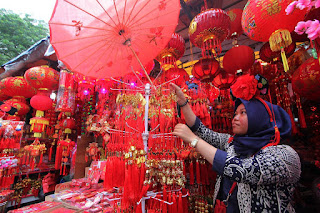
The Jakarta Post, 2 February 2006.  Chinese ornaments on sale in Glodok ahead of Chinese New Year. Often people identify the physical cultural symbols of others as a measurements of their level of identity. Less often, people go beyond symbols and seek actions, processes and outcomes. Imlek (Chinese New Year) may well be the annual climax of Chinese Indonesian identity expression -- regardless of who expresses it. I've been seeing red here and there, gold there and here. Gongxi Facai calligraphy, oriental ornaments, cheongsam in boutiques, barongsai dances, and many other things. It seems that Imlek gets increasingly festive with each passing year. Reactions to this are manifold, despite it being obvious that it is mainly the commercial sector that is providing the festive regalia. Money, perhaps, has no identity card. At one extreme, some claim that Imlek manifests the "Rise (or Victory) of the Chinese Indonesian". At the other extreme, "resinification"...