Postingan

OPINION: Spring sun over Sino-Japanese relations

Gambar
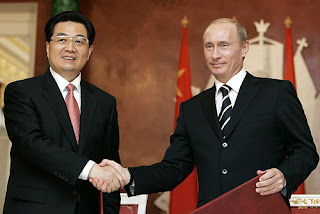
The Jakarta Post, 15 May 2008. As the warm spring breeze sweeps through Northeast Asia, hopes are floating high along with President Hu Jintao's just concluded visit to Japan, the first by Chinese president in a decade. Chinese President Hu Jintao (L) toasts with Japanese Emperor Akihito during a state banquet at the Imperial palace in Tokyo The charming President Hu chatted warmly with Emperor Akihito, enthusiastically posed with teary-eyed Japanese ballerinas after their white-haired lady dance performance that was very popular many years ago in China, visited historic temples that bear ancient bilateral history and amicably told story of Tang Dynasty's great poet, Libai, in front of young Japanese students of Chinese language class. Hu also extended panda diplomacy by offering to lend two giant pandas to Tokyo Zoo, which just lost its 22-year-old "native" panda, Ling Ling. Ping-pong diplomacy followed when he skillfully cracked the bat with China's female...

OPINION: The (Beijing) Olympics and Indonesia

Gambar
The Jakarta Post, 21 April 2008 In less than four months, the world will witness one of the biggest and widely discussed international events ever hosted by the People's Republic of China -- the Beijing Olympic Games 2008. Beijing is all geared up for the event. You can virtually sense the heightened atmosphere, and, no, I am not talking about the pollution. The Beijing Olympic symbol is virtually everywhere, on pens, on cups, on yogurt bottles, on the bus, on television, in magazines, etc. Poetic rhymed slogans -- such as, Yin ao yun, Jiang wen ming, Shu xin feng, loosely translated as "Welcome the Olympic, speak of civilization, establish new attitude" and You ya yan xing, You liang zhi xu, You zhi fu wu, You mei huan jing, or "Refined words and deeds, civil public order, quality service, beautiful environment" -- are plastered and scattered around the capital and other major cities in China. If there had been any debate about the inexistence of China's mo...

OPINION: Indonesian relations with China: Playing it hard, soft or smart?

Gambar
The Jakarta Post, 2 April 2007. Russia's "Year of China" has officially begun, following the success of last year's "Year of Russia" in China, which began after Chinese President Hu Jintao's visited to Moscow from March 26 to 28 this year. The two countries have been exchanging cultural and social "ambassadors" for the last two years. Such efforts have been attempts to bridge the gap between the dynamic progress of the high-level government relationship and the more stagnant development of people-to-people relations. Throughout 2006, China hosted over 300 Russian cultural and educational events, including several Sino-Russian economic forums with audiences in excess of 500,000 people. In Russia, the plan for 2007 is to have around 200 events Chinese-themed events, ranging from a national exhibition (which being feted as the biggest all-inclusive event held by China abroad for three decades), to media exchanges, cultural festivals and bu...

Refugee Review Tribunal Report on the Aftermath of Aceh Tsunami Situation

Gambar
On 17 January 2005, the Fellowship of Indonesian Christians in America (FICA) published an interview with Christine Susanna Tjhin, a Chinese Indonesian who worked with an INTI relief team in Medan which was tasked with investigating “the validity of rumors of persecutions towards Indonesian Chinese minority”. Tjhin, who is a researcher for the Jakarta based Center for Strategic Studies (CSIS), told FICA that “information from the first hand sources” revealed “that these were just unsubstantiated issues”. Though Tjhin did not herself travel beyond Medan and into Aceh itself, she felt informed enough to advise FICA that the rumour of “an organized and collective persecution in Aceh against the Indonesian Chinese” “was simply untrue”. According to Tjhin, the most significant incidents of xenophobic and/or sectarian agitation that she did learn of were the work of outside Javanese Islamist organisations, and not of the local Acehnese. Some relevant extracts follow in detail:  ...

OPINION: Seeing red: 'Imlek' and the politics of recognition

Gambar
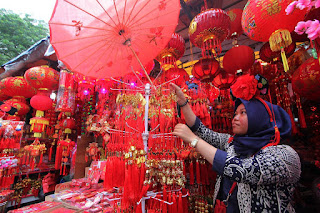
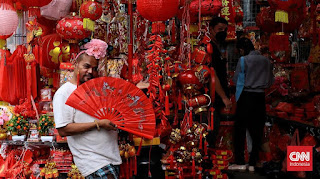
The Jakarta Post, 2 February 2006.  Chinese ornaments on sale in Glodok ahead of Chinese New Year. Often people identify the physical cultural symbols of others as a measurements of their level of identity. Less often, people go beyond symbols and seek actions, processes and outcomes. Imlek (Chinese New Year) may well be the annual climax of Chinese Indonesian identity expression -- regardless of who expresses it. I've been seeing red here and there, gold there and here. Gongxi Facai calligraphy, oriental ornaments, cheongsam in boutiques, barongsai dances, and many other things. It seems that Imlek gets increasingly festive with each passing year. Reactions to this are manifold, despite it being obvious that it is mainly the commercial sector that is providing the festive regalia. Money, perhaps, has no identity card. At one extreme, some claim that Imlek manifests the "Rise (or Victory) of the Chinese Indonesian". At the other extreme, "resinification"...

OPINI: Imlek, esensialisme, dan pengakuan

Gambar
Kompas, 28 Januari 2006 Pedagang pernak-pernik Imlek di Glodok menjajakan barang dagangannya. (Foto: CNN Indonesia/Andry Novelino). Imlek di Indonesia dari tahun ke tahun kian meriah. Di pusat perbelanjaan, televisi, reklame, koran, majalah, ornamen oriental, dan kaligrafi, Gong Xi Fa Chai bertebaran. Suasana Imlek sering dijadikan salah satu ukuran guna menilai "kebangkitan etnis Tionghoa". Penilaian itu beragam, dari "kemenangan" hingga "kebablasan", bahkan "resinifikasi". Imlek dijadikan salah satu strategi esensialisme ( essentialism ), di mana simbol-simbol identitas Tionghoa kembali dihadirkan dalam proses politik pengakuan ( politics of recognition ). Politik pengakuan Charles Taylor (1992) menjelaskan, dinamika identitas tidak terlepas dari politik pengakuan yang memiliki karakter dialogis ( dialogical ). Identitas individu terbentuk melalui proses dialog antara individu itu dan individu atau kelompok lain. Di tataran publik, ...

Wawancara Perspektif Baru: Perkembangan Dalam Peran Tionghoa

Gambar
PERSPEKTIF BARU BERSAMA WIMAR WITOELAR: Christine Susanna Tjhin adalah seorang peneliti di Center for Strategic and International Studies (CSIS) sejak 2003. Kami sering mendengarkan pandangannya di forum umum dan tulisannya di berbagai media, terutama juga kehadirannya dalam forum riset. Tapi yang kami ingin sorot sekarang beberapa pandangannya mengenai topik pembawaan perilaku peran kaum turunan Tionghoa di Indonesia. Ini bukan hanya karena dia keturunan Tionghoa tapi minat pribadinya dan juga terkait banyak aspek seperti dirinya sebagai peneliti, aspek kelompok minoritas, dan aspek perkembangan demokrasi di Indonesia. Menurut Christine, kini sudah mulai ada pergeseran pandangan pada etnis Tionghoa untuk pengakuan. Mereka melihat tuntutan untuk mendapatkan keadilan terhadap kejadian Mei itu sudah tidak kena strateginya. Kini mereka sudah punya semacam pemahaman bahwa perjuangan pengakuan terhadap komunitas Tionghoa itu tidak cuma di sana. Selain itu, pada saat ini juga sudah muncul ...

OPINION: Ending the cruelty of law

Gambar
The Jakarta Post, June 30, 2005. Almost seven years after reform, the rule of law as one of the key pillars of democracy remains a fragile one. In law enforcement, we seek the certainty of the law, but what we get is the cruelty of the law. According to the Indonesian Legal Aid and Human Rights Association's (PBHI) report for 2002, the police are responsible for 60 percent of reported cases of state violence. In 2004, another human rights organization, Imparsial, made similar conclusion after researching media reports on violence. Since the National Police separated from the Indonesian Military (TNI) -- as part of the reform of Indonesia's security sector and the democratization process -- the police have regained their full original mandate to protect and to serve the people, as stated in Law No. 2/2002 on the National Police. We know that police reform has not been as "popular" as military reform. The police face the extensive tasks of curbing corruption and...

OPINION: How the Chinese Indonesians share their wealth

Gambar
The Jakarta Post, February 12, 2005 It has been a hallmark of Chinese New Year (or Imlek) to share angpao (red envelopes) as a gesture of sharing wealth, luck and joy. What does a Chinese Indonesian have to share in this Imlek of 2556? In light of the tsunami catastrophe several Chinese Indonesian religious and cultural associations found it necessary to call for more moderate celebrations. Perhaps it was a futile call -- remembering how during New Year's Eve, less than a week after the disaster, frenzied parties were still held. After all, Imlek these days is no longer a closed family celebration. Since 2000 it has become a festive national occasion -- mainly thanks to the media and business sector. Nevertheless, the call is a sympathetic gesture that we ought to respect. Festive or moderate, Imlek is an expression, even at the most superficial level, of the extent to which Chinese Indonesians are freely able to express themselves and of how much they are generally accepted ...