Postingan

OPINI: Isu negatif di tengah bencana

Gambar
Koran Tempo, January 11, 2005 Di tengah hiruk-pikuk fatalnya bencana tsunami, meningkatnya jumlah kematian dan korban luka-luka, derasnya aliran pengungsi ke daerah aman, ramainya bantuan kemanusiaan dari berbagai penjuru, semrawutnya koordinasi aliran bantuan, dan simpang-siurnya informasi, masyarakat Indonesia masih harus menghadapi isu-isu yang berbau suku, agama, dan ras. Maraknya isu-isu ini merupakan konflik laten yang berpotensi besar menghambat jalannya proses bantuan kemanusiaan di Aceh dan Sumatera Utara, juga melukai kebersamaan masyarakat Indonesia yang beragam, yang selama ini terbangun secara alamiah dalam merespons bencana. Berdasarkan pengamatan dari tim relawan gabungan kami di Medan dan Banda Aceh, setidaknya ada beberapa rumor yang sudah berimplikasi besar. Isu penjarahan, pembakaran, dan pemerkosaan terhadap etnis Tionghoa, isu penganiayaan terhadap kelompok agama minoritas, dan beribu macam isu lain berseliweran, terutama melalui surat elektronik dan pesan pend...

OPINION: Wounding the spirit of humanity

Gambar
The Jakarta Post, January 8, 2005 The compassionate appeal made by Jusuf Wanandi to all citizens, particularly Chinese-Indonesians, to help Aceh and Indonesia cannot be emphasized enough (The Jakarta Post, Jan. 4). The caution to dismiss politics in the long-term handling of humanitarian aid goes hand in hand with the urgent need and grim future of the tsunami victims and refugees. The opportunity for reconciliation may be in peril because of racial and religious prejudices, if you believe the rumors circulating around Aceh, Jakarta and beyond. Based on our observations in the field, there are several major issues that could cause conflict. At stake is not only the rehabilitation of Aceh, but also the very foundation of Indonesian unity. False stories about looting, burning and rape targeting the ethnic Chinese in Aceh, the abuse of religious minorities and other rumors have been circulating via email and SMS. Some people responded to these ridiculous rumors by calling for a stop...

OPINI: Partisipasi Politik Tionghoa dan Demokrasi

Gambar
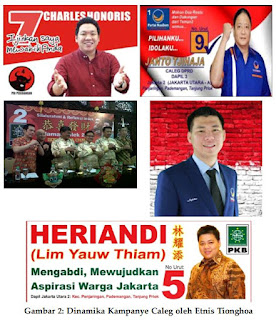
Kompas, Opini - 20 September 2004. JIKA selama Pemilu 1999, komunitas Tionghoa tampak malu-malu dan agak canggung dalam berpolitik, dalam Pemilu 2004, partisipasi politik komunitas Tionghoa terlihat semakin dinamis dan asertif. Bagaimana membaca dinamika itu secara kritis? "Binatang ekonomi" dan "apolitis" adalah dua stigma populer yang berurat-akar bagi orang Tionghoa. Persepsi mayoritas elite politik Indonesia tampaknya masih berkutat di situ karena menilai partisipasi Tionghoa sebatas keuntungan ekonomis. Persepsi ini adalah buah dari asumsi tidak mendasar bahwa komunitas Tionghoa yang hanya 2 persen dari populasi menguasai 70 persen perekonomian nasional. Citra kekuatan ekonomi komunitas Tionghoa memang sudah ada sejauh sejarah kolonial. Tetapi label 2 persen dan 70 persen menjadi hingar-bingar di akhir tahun 1990 an seiring krisis ekonomi Asia, dikarenakan tendensi bombastis sejumlah jurnalis masa lalu yang salah mengutip penelitian Michael Backman (1...

OPINION: Minority participation and democratization

Gambar
The Jakarta Post, 3 September 2004 Since the legislative election in April, more Chinese-Indonesians have undoubtedly been engaged in the country's democratization, and this degree of enthusiasm is a new precedent for their future participation. In the past, the only "participation" expected concerned economic activities. The reconstruction of the Chinese-Indonesian identity was shaped much by such economic preferences, which led to the stereotypical stigma that the ethnic group, which comprises 2 percent of the Indonesian population, makes up 70 percent of the economy. Although no valid proof exists to indicate the precise economic power of Chinese-Indonesians -- nor any to calculate the economic power of other ethnic groups in Indonesia -- this "popular" stigma has stuck. The notion of Chinese-Indonesians holding economic power has held sway for as long as the nation's history, particularly since the colonial era. However, this stigma was amplified i...

OPINI: Belajar dari tragedi Minamata

Gambar
Kompas, August 31, 2004. Tragedi Minamata dan tragedi lainnya menggeser perilaku Jepang atas lingkungan. Perubahan tersebut ditandai dengan kelahiran kosakata baru, "kogai", yang berarti penghancuran domain publik (Jun Ui, 1992). Meskipun kasus Minamata berhasil dimenangi oleh warga, banyak yang menyesali bahwa andai direspons lebih cepat, kasus ini bisa saja menjadi sentra krusial yang menjadi titik pusat perubahan ekonomi politik Jepang yang membentuk perilaku terhadap lingkungan yang lebih baik di masa yang akan datang.    Seandainya hal ini tercapai, Jepang tidak perlu menghadapi tragedi-tragedi lingkungan lainnya (penyakit itai-itai, asma Yokkaichi, dan lain-lain) yang memukul sedemikian kuat. Haruskah kejadian setragis Minamata terjadi dulu di Indonesia sebelum kita semua menyadari apa artinya lingkungan bagi kehidupan kita? Perdebatan tereduksi pada apakah warga Buyat menderita Minamata atau bukan. Apa pun jawabannya, fakta menunjukkan bahwa faktor lingkungan ...

OPINION: The return of the old New Order measures?

Gambar
The Jakarta Post, 1 June 2004. While all five presidential candidates vehemently flaunt their commitment to upholding human rights and democratization, some members of the House of Representatives and security authorities seem to be throwing spikes down onto the path of civil society toward democratic consolidation, preparing for an ambush. On May 26, after a meeting with House Commission I, National Intelligence Agency (BIN) chief A.M. Hendropriyono announced the agency was probing into an earlier report concerning the activities of 20 local and foreign non-governmental organizations (NGOs). These NGOs have allegedly produced reports that could instigate national security concerns during the presidential election. Further investigation to compile more incriminating evidence is also said to be underway. The government took a rather defensive position in response to the NGOs' reports and claimed a right to take measures against those who threatened national interests, which ...

OPINION: More Chinese Indonesians Become Actively Engaged in Politics

Gambar
The Jakarta Post, March 29, 2004. "If the world knows about 12 Chinese signs of the zodiac, Chinese-Indonesians know only of two -- the cash cow and black goat," joked Mely G. Tan years ago. The sardonic joke seems to have endured throughout Indonesian history and may be further accentuated in the 2004 elections -- or not. The post-1999 political climate has been more conducive to greater participation. Increased Chinese-Indonesian participation as legislative (House of Representatives) and Regional Representatives Council (DPD) candidates can clearly be seen -- 172 so far, as noted by The Jakarta Post. Quality, however, is not as apparent. Last Saturday, Paguyuban Sosial Marga Tionghoa Indonesia (PSMTI) and Forum Masyarakat Tionghoa (FORMAT), two of Indonesia's distinguished Chinese-Indonesian associations, cohosted a "Meet the Chinese-Indonesian candidates" gathering. Three DPD candidates and 12 legislative candidates of Chinese descent from 8 different politi...

OPINION: Civil society after Akbar's acquittal

Gambar
The Jakarta Post, 17 February 2004. A friend won a bet on Akbar's release. ""I told you so! Our oh-so-reliable Supreme Court will release him!"" he said sarcastically after claiming his prize -- a bag of peanuts. The release of Akbar Tandjung was the climax to disappointments over the Indonesian judicial system throughout the reform period. Some said it was to be expected. Yet, it tasted despicably bitter when it actually happened. Saying that the Supreme Court has no sense of crisis would be the understatement of the year. It is rather comical to hear those who urge the public to ""respect"" the Supreme Court's decision, as the judiciary has made a mockery of justice, as well as democracy. Fortunately, civil society does not use force to challenge this mockery of justice, although, there has been violence on the streets involving students. Since the Indonesian judiciary seems to have very little conscience, it cannot be relied up...

OPINION: Torture, police and legal reform, democratization

Gambar
The Jakarta Post. On Nov. 15, 2003, the National Commission on Human Rights (KOMNAS HAM) announced its preliminary findings about human rights abuses by the TNI and National Police in Papua. On the same day, cases of torture and judicial killings by the police in Maluku were also reported. Torture cases have been "public secrets" for many years. Torture cases with differing gravity can be found in almost all police stations or military posts in areas of conflict all over Indonesia. Let us clarify what torture means. Article 1 of the International Conventions Against Torture and Other Cruel, Inhuman or Degrading Treatment or Punishment (CAT) states that torture is "any act by which severe pain or suffering, whether physical or mental, is intentionally inflicted on a person" by state apparatus (police, military and others). The purpose can be to obtain information or confession or to punish that person (or a third person). The person may have committed or have b...